

Trinity In Twelve Weeks

- Career Planning
- CVs and Cover Letters
- Networking
- Interviews
- Work Experience and Internships
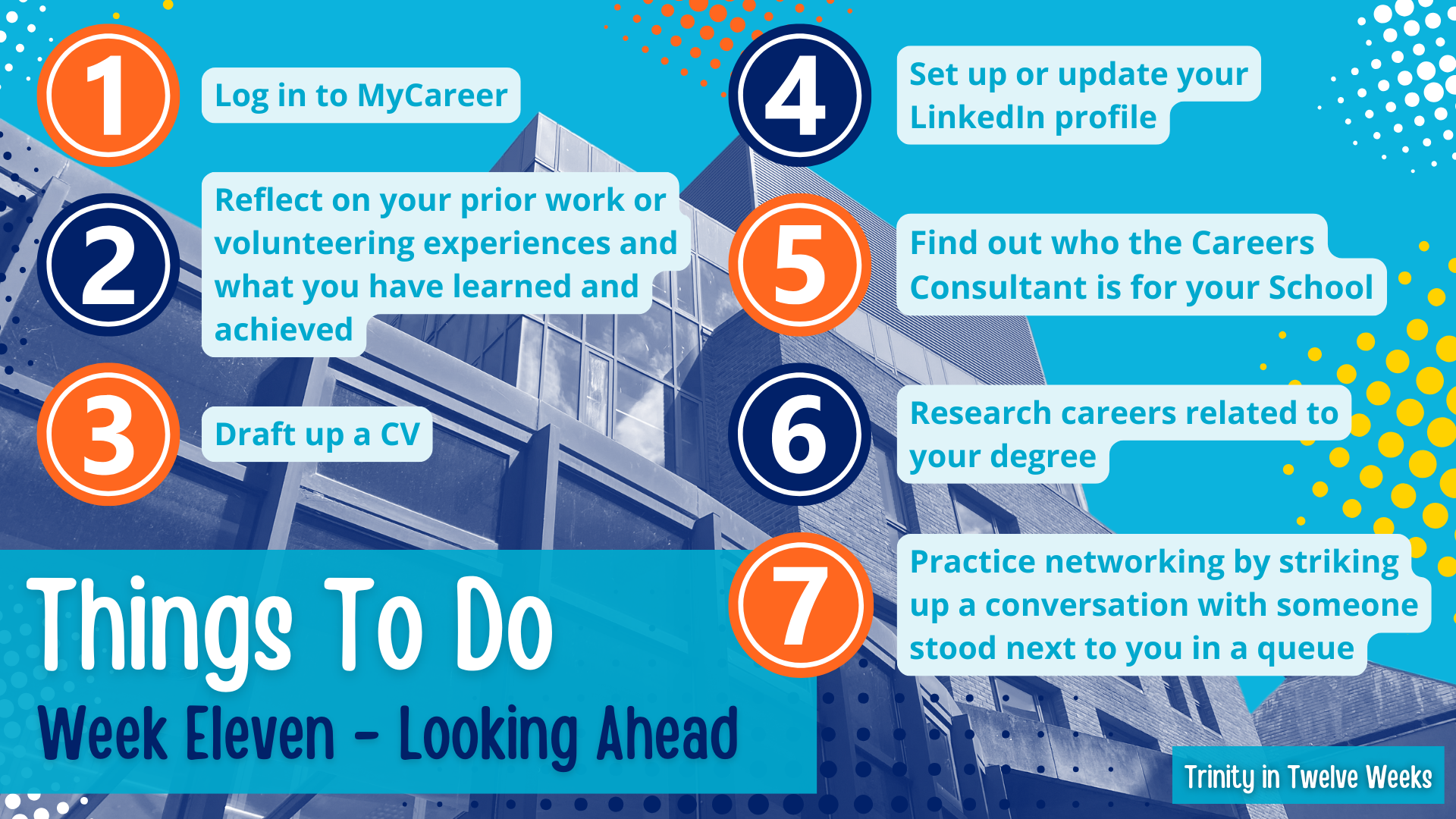
Career Planning
Why Start Career Planning Now?
It might seem a bit early to start thinking about what you want to do after College given that you haven't even finished your first semester, but it's a good idea to consider where you would like to go after you finish studying and how you might get there. This includes thinking about what kind of job you might like to have, and what you can do while in College to increase the chances of you being successful in pursuing your goals.
You don't need to lay out a master plan and follow it to the letter, but it's not too early to be looking into internships and summer work that might benefit you in finding a job after College, and to actively be thinking about what you are enjoying learning or working on and what you think won't be for you.
How To Do It
Start by thinking about the following:
- What really motivates your work?
Your beliefs and values are important here! - What are your interests?
Both academic and extracurricular. - What type of career and work culture might suit you best?
Would structure suit you or stifle you? Do you prefer working independently, or as part of a team? - What are your strengths?
What skills do you have? - How emotionally intelligent are you?
This refers to how you manage your own emotions and the emotions of others. Reflecting on how emotionally intelligent you are, in combination with the other factors above, may help you to choose or eliminate certain careers or work settings.
A four-stage, cyclical career planning process can assist you in making career decisions throughout your time in College and afterwards:
- Know Yourself
- Explore Opportunities
- Make Choices
- Take Action
There are some questions below that will help you with these four stages.
Know Yourself
- What do I want from my career?
- What do I offer in terms of skillset, abilities, and knowledge?
- What am I interested in? What am I passionate about?
- How would I describe myself? How might others describe me?
- Am I open to new ideas and experiences? How curious am I?
- How good am I at monitoring my own emotions and those of others?
Explore Opportunities
- What jobs and employers are out there?
- What sectors are hiring at the moment?
- Which aspects of my work experiences to date have I enjoyed/not enjoyed? Why?
- Who do I know in the working world who can help me?
- Do I need a postgraduate qualification to get into this field?
- What impact or contribution did I make in each of my work experiences?
Make Choices
- How do I tend to make important decisions?
- Which career options most appeal to me? Why?
- Do I have a contingency plan?
- Who or what got me interested in this area?
- What are the practical considerations that apply to me? e.g. budget, time, energy, location etc.
Take Action
- Are my CV and LinkedIn profile well-tailored to my sector of interest?
- When is the Careers Service's next drop-in CV Clinic?
- Is there an upcoming Careers Fair I should attend? How should I prepare for this?
- Do I need to book a practice interview?
- Which careers workshops will most help me?
Useful Tools
The Careers Service provide access to a number of online tools to support you in career planning. There are also several publicly available tools which may be of help. Some of those most relevant for first years are:
- MyCareer (Only available to TCD students and graduates)
- Database of career and more casual work opportunities and events available to Trinity students.
- Map My Future (Certain elements only available to TCD students and graduates)
- This careers framework supports you to identify future career options by reflecting on your current experiences, wants, and needs.
- Profiling for Success Personal Assessment Programme (Only available to TCD students and graduates)
- Identify your learning style, career interests, and more!
- CareersPortal.ie
- Particularly useful for people considering changing their course of study.
- Identify and explore which career sectors your degree course best helps to prepare you for.
- Identify and explore courses which best prepare you for your dream career sector.
- Shortlist careers and courses that match your interests.
- Database of generic job descriptions (including many video case studies), with information on the current state of the labour market and how to get into the area.
- Qualifax
- Particularly useful for people considering changing their course of study, or researching postgraduate qualifications.
- As the national learners' database for Ireland, it provides the most comprehensive information on further and higher education and training courses.
- Offers calendar of further/higher education informational events, and information on grants.
CVs & Cover Letters
What are CVs and Cover Letters?
Your CV (which stands for Curriculum Vitae) is used to introduce yourself to a prospective employer, providing an overview and confirmation of your skills, abilities, and experience with the goal of being invited for an interview.
Your cover letter highlights elements of your CV, skillset, and experiences which may be of particular relevance and interest for the prospective employer, demonstrating your research of the role and organisation, and how you specifically meet some of their important requirements.
What should be in your CV?
Your CV should be no more than 2 A4 sides, and should be clear and concise. It should be visually appealing, but not busy-looking. You should tailor it to the organisations you are applying to and what their corporate culture is.
Personal Details
- Name
- Address
- Contact telephone number (landline and/or mobile)
- Email address
- Date of birth (optional)
- LinkedIn profile
To save space, put your personal details in the header of your CV with your name as the focus (it should jump out from the page when you glance at it).
Career Objective / Personal Statement (optional)
This identifies what you are aiming for and what skills you have to offer in relation to your objective. It can be useful when confirming your interest in a particular job or employment sector, and/or when your experience is more limited.
Education & Qualifications
- Put your most recent qualification first.
- Give the full title of your degree, e.g. B.B.S. Honours Bachelor Degree in Business Studies, not BBS or BESS. (Make sure to spell 'Bachelor' correctly!)
- Show the time frame and structure of your degree (recruiters may not realise that most TCD undergraduate degrees are four years long).
- List your overall grades and the breakdown of subjects within your degree (especially those relevant to your application).
- If you studied outside of Ireland, indicate your qualifications' equivalence if possible.
- Give your Leaving Certificate (or equivalent) results, but leave out your Junior Certificate grades.
Employment History/Other Experience
- Start with your most recent job.
- Employers are interested in any work experience, whether immediately relevant or not.
- Don't forget to list any part-time/holiday/voluntary work experience that you have.
- Emphasise both what you learned and how you made a difference to your employer.
- Provide detail of how you reached decisions, planned activities, and worked with others to acheive results.
- Emphasise the skills gained in each role.
- If you are a mature student, here is an opportunity to shine, as previous full-time work experience - at whatever level - can be used to provide evidence of the skills and qualities required for a role.
- Present your interests, voluntary work, involvement in clubs and societies, etc. in the same manner as your work experience, just below your work experience; this gives it value.
Skills Profile (optional)
This is an opportunity to show how your overall experience matches the requirements of the job. Use it to draw together different experiences under one core skill. For example, you might demonstrate your aptitude for 'teamwork' through your participation in group projects, youth club(s), and travel experience - particularly if you have not referred to skills gained through these activities elsewhere.
Make sure to highlight your IT skills, languages spoken, driving licence, etc. if not already listed.
Referees
List two or three referees (including one academic reference) on your CV. Get someone's permission before you use them as a referee, and include their name, job title, work organisation, (work) email, and telephone number.
You can also say 'References available on request' on your CV instead of listing them, but if an employer wants to contact your referees you will have to provide details, so make sure you have at least two who will be able to tell them how great you are.
Types of CV
There are a few different ways to present your CV depending on what you are applying for, and your own skills and experience. Two of them would be the most relevant for you writing your CV as a student.
Chronological/Combination CV
List your education, jobs, and work experiences in chronological order - most recent first. List duties and/or achievements and skills gained after each work experience or educational 'entry.' Be succinct in your wording (less is more in terms of impact!) and start each phrase with a verb, e.g. assisting, completed, managing, awarded etc.
Advantages: Emphasises continuity and career growth. Highlights name of employer and position held, and is easy to follow. Highlights achievements.
Disadvantages: When your work history is irregular, or if you have changed employers frequently.
Best used: When your career direction is clear and the target job is directly in line with your work history/experience. (However, when the career objective and skills profile are utilised effectively, this form of CV can also be used where the job target is not directly in line with your studies/experience).
Skills-Based CV
Here you categorise your work experience and education according to your skills and capabilities. This style of CV highlights major areas of accomplishment and strength and organises them in a way that will best support your application for a specific role.
Advantages: Gives you flexibility in emphasising skills and abilities. Eliminates repetitive work experience details.
Disadvantages: Not suitable for employers who would prefer a more traditional CV, or if you have a limited range of experience.
Best used: In cases of career change or re-entry into the job market. Can be very effective when you wish to stress a particularly strong area of ability.
Cover Letters
A standard covering letter:
- Is formatted as a letter, with the date and address of composition given.
- Is a single typed side of A4 paper only.
- Includes the full, correct job title of the role you are applying for.
- Outlines your current situation: 'I am looking for summer work in 2025.'
- Highlights your suitability by reflecting the needs of the company as outlined in the advertisement or job description and showing how your skills, qualities, and experience 'match' these needs.
- Provides relevant examples.
- Displays a positive and enthusiastic tone throughout.
- Concludes by reiteraing your interest in the role.
- Features a typed or printed version of your name underneath your signature.
Networking
What Is It and Why Is It Important?
You might think of networking as simply a business transaction. You go to a networking event, you try to meet people who are useful to you, have a free sandwich, and go home. However, networking is actually something you do every day; every new person you speak to, and every connection you deepen, enhances your social network. You are always meeting people, so learning how to break the ice and have a conversation with a stranger is an invaluable skill.
Aside from the social benefits of having friends and other acquaintances, there are two other reasons to build your network through your life (starting now!):
- For opportunities
- For support
1. While it is great to meet an important person who may be able to offer you a job today, it is also important to build professional relationships with people who don't seem to provide immediate career benefits for you. As your life and circumstances change, and as their lives and circumstances change, you may find yourself in a position to take advantage of an opportunity they have for you, or you may have an opportunity for someone else. And, of course, you may find yourself with a new friend!
2. Your network can be a great source of support when things go wrong. The more authentic your relationships are with your network, the more you will find yourself able to rely on support - whether you didn't get a job you wanted, or perhaps lost one. Your network can also support you when your work is going well; everybody looks at the world through a different lens, and discussing the project you are working on with a classmate or colleague may provide some new ideas.
Where To Talk To People
One of the easiest places to start a conversation with someone is in a queue, or - more generally - whilst you're both waiting for something. When you're leaving your lecture theatres, for example, and you're waiting for everyone to get onto the stairs and out the door. Or, when you sit down next to someone when you arrive to class. Waiting for food or drink at a bar or a counter is another time you can start a conversation with the person next to you. Or standing in a bathroom queue! If you stand sideways in a queue, it's easy to start a conversation with the person behind you (we'll get on to what to say shortly).
If you are at an event (and you don't see any obvious queue you can join!), it can be difficult to know if a group of people talking together will welcome a newcomer or not. However, there is often a way to tell.
Look at the body language of the groups in the room:
- A group that is standing facing each other, with their backs to the rest of the room and no gaps between members, is a closed group. Closed groups are more difficult to approach and start a conversation with, as you will likely have to ask someone to move to let you in. They may also be having a more private conversation.
- You should look for open groups. Open groups will leave gaps for other people to approach the group and join in the conversation. They will tend to face outwards to the room as well.
The diagram below is an illustration of what this can look like in real life.
What To Say
Now that you have identified someone to talk to, you need to have something to say. This doesn't have to be elaborate - after all, you are only starting a conversation! Simply say hello and introduce yourself.
Next, the first thing anyone typically asks of a stranger is 'what do you do?' (everyone wants to know what other people do). This may lead to a natural conversation all by itself, and, if so, good work - you are now networking!
Sometimes the question 'what do you do?' produces awkwardness, and someone doesn't want to talk about it. This is not an opportunity for you to talk at length about what you do. Instead, you should have some backup conversation topics. Two very simple ones that anyone will relate to are:
- What has just happened?
- What is happening next?
For example, if you are leaving a lecture, you can discuss what just happened in class with someone new, and the shared experience should make it easier to keep the conversation going. You can also talk about what is about to happen - what class is up next and what does the person think about it?
If this all sounds suspiciously like making friends, that's because it basically is. It's important when networking, as when making friends, to listen more than you talk, and to be genuine.
When you are confident approaching strangers and starting conversations, then you should practice what you want to say, and keep developing your skills from there!
How To Get Away From Someone
So you've done it, you're at an event and you have successfully networked, but now you're in a conversation with someone you've realised you do not want to be talking to. How do you escape gracefully?
Easy.
The two most-used excuses are two of the most reliable and least rude: 'I need to get a drink' and 'I must go to the bathroom'. If you don't intend on coming back to speak to them, choose your excuse, say 'It was lovely to meet you,' and walk away.
Now that you have escaped, you can start your networking again in the queue at the bar or the bathroom!
Interviews
How to Prepare
Congratulations! You've secured an interview. If you've been invited for an interview it means that your CV and cover letter showed that you meet the basic requirements for the job. The interview is your opportunity to outshine the other candidates. To do this, you need to prepare thoroughly - as hard as you would study for an exam. Here are 5 steps to prepare for an interview.
1. Focus on the Job
- Read the original advertisement or job description and check that you understand what the position entails.
- Improve your knowledge of the company.
Read their website, brochures, or annual reports. Check social media for current news about the organisation. How many people does it employ? What backgrounds do they have? - If possible, talk to someone who works at the company.
Use the Trinity alumni community to identify alumni who may be working there and who can give you some informal advice and information.
2. Establish the Ideal Candidate
- From your research you should be able to work out a list of ideal qualities, skills, and competencies required for the position.
For example, self-motivation, problem solving, communication, creativity, and teamwork are some of the skills that employers will look for. - Think about times when you have demonstrated these qualities and skills.
Remember - specific examples are key!
3. Plan your Interview
- Match specific examples drawn from your own experiences to questions that you think the interviewer may ask to establish if you are the most suitable candidate.
- Provide evidence of your successes.
The employer is recruiting you for your strengths, and your achievements are evidence of those strengths. If possible try to identify measurements for those achievements, eg. "increased membership of the Tiddlywinks Society by 50%".
4. Practice
- Role-play a practice interview with a friend.
Get them to give you feedback! - Practice talking aloud to yourself in front of a mirror.
- Assess whether you are giving coherent and relevant answers.
- Ask yourself, what does your body language say?
- The Careers Service can offer you a practice 1:1 interview with one of their specialist careers consultants.
Visit their website for further details.
5. Be Attentive to How You Present
- Dress appropriately for the job and sector.
If in doubt, formal business attire is recommended. - Be respectful, professional, but also yourself!
Golden Rules for Answering Questions
- Be enthusiastic, listen actively, lean forward slightly, and maintain healthy (but not overly intensive!) eye contact with the interviewer(s).
- Be prepared to expand on something which seems to interest the interviewer(s). Cut to short descriptions when they are clearly not so interested.
- Reply to the question that is asked, not the one you might like to answer - in other words, listen. Undoubtedly there will be questions that are difficult to answer, but answering these thoughtfully offers an opportunity for you to shine.
- Ask for clarification - don't pretend to know something that you do not or try to answer a question you have not understood.
- Be ready to recognise simple questions calling for brief answers.
- Speak clearly, but not too fast.
- Don't interrupt the interviewer.
- Always be positive. Even when things have gone badly for you, try to think positively about what you have learned from the experience.
- Promote your strengths - leave others to identify weaknesses.
- Try to avoid mannerisms - don't fidget.
- At the end of the interview you will have a chance to ask questions. Have one ready.
Work Experience and Internships
Why get Work Experience or do an Internship?
As the jobs market becomes increasingly competitive, relevant experience is critical. Most employers will expect students to have gained some form of tangible experience during their College years.
Experience takes many forms, including: involvement in clubs and societies; community work; paid or unpaid work; an internship as part of your degree course; a structured work experience with a large employer; a laboratory- or fieldwork- based internship; a short period of work shadowing negotiated by you with an employer.
Benefits of getting work experience:
- It significantly boosts your chances of securing your desired job after College.
- It can provide a unique selling point on your CV/application that allows you to stand out from your competitors and highlight your (new) skills and achievements.
- It can enhance your employability and job prospects after graduation - up to 80% of graduates in UK companies are recruited from internship programmes.
- It offers opportunities to create a network of potential contacts for the future.
- It provides pportunities to test out what it is like working in particular environments/jobs/sectors.
- Any form of work experience can highlight your motivation to a prospective employer.
- If your work experience is linked to your course, it can provide you with the opportunity to put course theory into practice.
- You can learn new knowledge and skills - both course-related (if applicable) and personal.
- Work experience gives you insight into working life, helps you to develop your self-awareness, and supports you in making good career decisions.
- You earn money!
Types of Work Experience
Internships
Internships are structured work experience programmes during which students receive supervised, practical experience in a career-related area. Internships usually last between 8 and 12 weeks, and are a great way of helping you to clarify your future career path.
- Training: is provided, generally to a high level.
- Project Work: You are generally given responsibility for a specific project during an internship and are required to present on it at the end of your placement.
- Advertising & Closing Dates: Holiday/summer positions are generally advertised between October and March. Closing dates are often early in the academic year, with some as early as December.
- Target Cohort: Junior Sophisters are the main target cohort for internships, but applications may be accepted from students in other years. Students from ALL disciplines are invited to apply - for example, Arts & Science students are often encouraged to apply for business internships.
- Competition: Competition for internship places is tough, but keep in mind that an estimated third of graduate vacancies are filled by applicants who have already worked for their employer as an undergraduate. Participating in an internship programme is a great way to get your foot in the door if you are looking to work in a particular sector or organisation after graduation.
You may not be successful in applying for an internship in first year, but it is a good time to research what internships are out there and what companies are looking for in their interns so that you have the best chance of being successful when you do apply.
International Work Experience
More and more students are going abroad during the summer and winter months. There are a number of programmes in place to help you to identify career-related vacancies. For example, BUNAC and JENZA offer a range of opportunities - from working in US summer camps to UK festivals to Japanese ski resorts.
Whilst international work-experience companies can provide information on any visas you may need to work in your chosen destination, it is also very important than you consult guidance from the Department of Foreign Affairs and Trade to ensure that you have all necessary paperwork in place and are aware of the latest travel advice prior to departure.
Part-Time Work
ALL work can provide learning opportunities. Many students work part-time during their studies (e.g. in restaurants, shops; as tutors, cleaners, etc.) and gain valuable transferable skills such as business, systems, and operational knowledge, time-management, and and organisational abilities.
Make sure to talk to the Careers Service if you need some advice on how to articulate your part-time work experience effectively in your applications and at interview.
Placements with Small Businesses
A placement with a small business can also be extremely valuable experience - particularly as you will often have more responsibilities (a.k.a. opportunities to build skills) when working with such an organisation than you would on an internship for a large company.
You might decide to set up your own small business. Remember that can get help with this from the Open Incubator community and resources and the Launchbox programme.
Volunteer Work
Voluntary work typically involves more variety and responsibility than you might experience in a paid job. It is a great way of getting valuable work experience and building up critical skills relevant to any job.
There are often voluntary projects designed specifically for students taking place during the summer months. Although they are voluntary, you will probably have to pay for your own flights and some additional administration costs if the opportunities are located overseas. For more information please visit: studentvolunteer.ie
Where to Find Work Experience
- The Careers Service's MyCareer portal is your one-stop shop to kick-start your career journey. Apply for part-time, internship, and graduate job opportunities. Attend career-focused events and career fairs. Register for skills sessions. Sign up for the Trinity Career Skills Award. Book your 1-1 career appointments. All in one place!
- TCDSU / AMLCT host a virtual jobs list on their website.
- You can also contact companies directly, with your cover letter and CV, to inquire about possible opportunities.